About
Well, somehow you ended up here. It's probably worth explaining why that happened…
I always hated studying language as a student. I learned a little French in high school and college* and did Hebrew school for Bar Mitzvah prep at my family's shul. With French I could understand a tiny fraction what I read or heard, and with Hebrew I could read the letters and make the sounds, but basically had no knowledge of what any of it meant.
Somewhere along the line, I heard about Svara style Talmud study. The idea of this method is that as long as you know the alef-bet, you can read a text. This sounded interesting, but improbable to me. I have enough interest in Jewish learning that the concept piqued my curiosity, so when I learned that there was a group doing this in Seattle, I signed up for a class.
Hebrew and Aramaic** are based on three-letter roots that get transformed by additions (and sometimes subtractions) of letters, so you can figure out what a specific word on the page means by learning the rules of how roots become words. Those rules exist and are real, and a conventional language program would focus on drilling what those rules are through memorization, at which point I probably would have checked out. Instead this teaching method pairs you up with a partner (if possible, aiming to pair up people of equivalent skill level) and hands you a sheet that lists what the prefixes and suffixes are. Then you get set loose with a dictionary, your partner, a notebook, and you try figure it out. And that's where the magic is. You're no longer learning a language, you're solving a puzzle. After a period of time (and a snack break), the whole class reconvenes and discusses what everyone found and the teacher provides a guide for what the words really are so the group can talk about meaning.
For a certain type of brain, this is incredibly fun, and a little addictive. I kept coming back every time a class was offered, and was lucky enough to be in the introduction to Biblical Hebrew course that my teacher was developing. At a certain point, I did feel like the starting methods are really helpful, but I wanted to have a firmer foundation. As it turns out, working more directly with the grammar is even more my jam.
It was during that class that most of what is on the website started coming together. In writing notes and homework for that class, I would either not leave myself enough room for the vowels under the letters, or I would leave myself so much space for the vowels that I basically putting one page of notes on two pages. That would gradually become the bigger notebook project. It also inspired me to do larger scale translation projects, so Dag Bavel became a reality.
About the name…
In the immortal words of Armin Tamzarian: "We need a name that's witty at first, but that seems less funny each time you hear it."
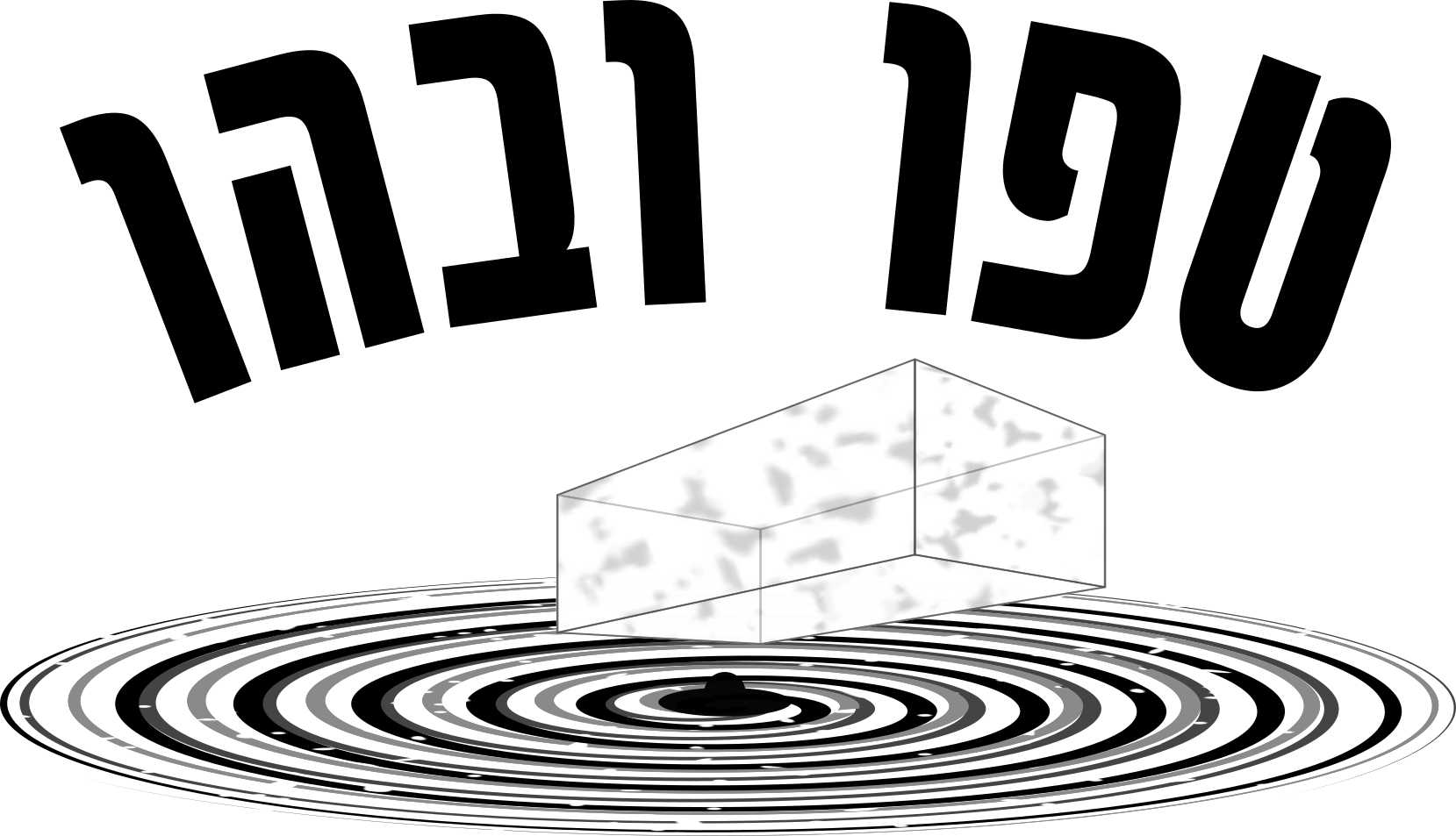
I woke up in the middle of the night with the phrase "tofu vavohu" rattling in my brain and chuckling to myself. I scribbled it down on a piece of paper and went back to sleep and ended up still enjoying it in the morning (which is pretty rare for something written down in the middle of the night in my experience). I love a dumb pun, and this is about the dumbest pun one can make. In Genesis 1:2, before anything is created, the land is described as "תֹהוּ וָבֹהוּ (tohu vavohu)" meaning "formless and empty." A flavorless block of soy protein is not really all that different from the primordial moment of non-existence, and tofu does exist as a loan word in modern Hebrew, so I started using the phrase as a moniker.
________
* I also took a Japanese class in high school, but that stuck even less…
** Other Semitic languages, notably Arabic, work in a similar way.